
Arabic alphabet · Reading marks
Sukūn in Arabic: reading a consonant without a following vowel
A small circle changes how you read: the consonant is still pronounced, but no short vowel follows it. Identify sukūn, put syllables together, and practice with words that show vowel marks.
Beginner · Modern Standard Arabic · Exercises with answers
Your goal
Read a consonant with sukūn without adding an a, i, or u sound. Prerequisites: recognizing some letters and the three short vowels.
01 · Recognize the mark
What does sukūn mean?
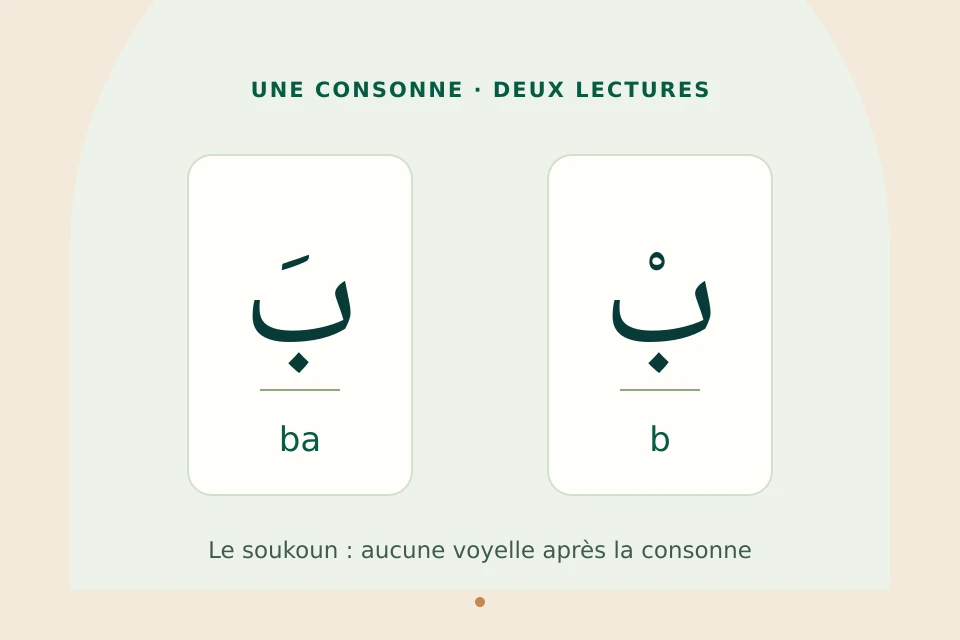
The soukoun, also transliterated as sukūn or sukun, is usually written as a small circle above a letter: بْ. It indicates that no short vowel follows this consonant. The mark is part of Arabic vowel marking; it is neither an extra letter nor a fourth vowel.
Compare بَ, بِ, بُ and بْ. The first three forms are read as ba, bi, bu. The last represents the consonant b, without an added vowel. To practice it, place it after a vowel already present: أَبْ, ʾab. This sequence is used here as a reading exercise.
The consonant does not disappear
“Without a vowel” does not mean “silent.” In مِنْ (min, from), the نْ is pronounced. You end on n, without turning the word into mina or mini.
Sukūn does not call for a pause between letters either. Within a word, keep reading normally. Do not interrupt your breath after every consonant with this mark.
02 · Put the sounds together
How to read a letter with sukūn
- Find the preceding vowel. Start with the consonant and vowel that precede the sukūn.
- Continue into the consonant without a vowel. Read both elements in a single movement: mi + n → min, without saying the letter’s name.
- Continue if the word goes on. The next consonant has its own vowel. Sukūn does not remove any other syllable.
In مَكْتَبٌ (maktabun, desk), the كْ closes the first syllable: mak-ta-bun. The vowel a after تَ remains. The ending -un corresponds to the tanwīn written on the final letter; here, we read it as shown.
A final consonant
هَلْ
hal · question particle
Pronounce ha, then l. Do not add anything after the lām.
In the middle of the word
يَكْتُبُ
yaktubu · he writes
Put together yak-tu-bu. The kāf has no following vowel.
Another closed syllable
دَرْسٌ
darsun · lesson
The rāʾ has sukūn; the sīn has the ending -un.
With a consonant that briefly closes the airflow, such as كْ, do not produce a vowel to make it “more audible.” With مْ or نْ, simply maintain the required articulation without artificially lengthening the sound.
03 · Avoid confusion
Sukūn, missing vowel marks, and shadda
In a fully vowel-marked text, sukūn gives explicit information. In an everyday text without marks, a bare letter does not automatically mean “a consonant without a vowel.” The same letters can have several readings: vocabulary and the sentence help you choose.
Shadda بّ has a different role: it marks a doubled consonant. Sukūn بْ does not double the consonant. To understand the difference, compare their roles without confusing consonant length with the absence of a vowel.
Wāw and yāʾ
In بَيْتٌ (baytun, house), the sequence بَيْ is pronounced bay. In يَوْمٌ (yawmun, day), the sequence يَوْ is pronounced yaw. Yāʾ and wāw are therefore not always long vowels. Also look at the mark on the preceding letter: these two examples are not read as bītun and yūmun.
Connected speech and pauses at the end of a word
The examples in this lesson retain grammatical endings when they are written. At a pause, some endings are read differently. Pausal pronunciation is a separate topic: do not replace every final mark with sukūn in your exercises.
04 · Correct your reading
Three mistakes to spot
- Adding a small vowel. If مِنْ becomes mini, repeat slowly and end your voice on the final consonant.
- Leaving out the consonant. If هَلْ becomes ha, place your tongue to articulate the lām before finishing.
- Reading letter by letter. In يَكْتُبُ, do not say the name “kāf.” Put the sounds together, then read the word again in one movement.
First aim for accuracy, then a more natural pace. A recording of Standard Arabic or feedback from a teacher can help you check that no unwanted vowel has slipped into your reading.
05 · Your turn to read
Sukūn exercises with answers
Do each exercise before opening its answer. Transliteration helps you check the structure; it does not replace listening to Arabic sounds.
1. Identify
Which letter has sukūn in مِنْ, دَرْسٌ and يَكْتُبُ ?
Show the Answer
In order: nūn نْ, rāʾ رْ and kāf كْ. Each is read without a short vowel immediately after it.
2. Choose the correct reading
For مَكْتَبٌ, choose maktabun or makatabun. What information lets you decide?
Show the Answer
Maktabun. The sukūn on كْ rules out the extra a in the second option.
3. Read without transliteration
Read هَلْ then بَيْتٌ and يَوْمٌ. Keep the written endings for both nouns.
Show the Answer
Hal, baytun, yawmun. Sukūn appears, respectively, on لْ, يْ and وْ. Try again without looking at the Latin letters.
Frequently asked questions
Your questions about sukūn
Is sukūn a vowel?
No. Sukūn indicates that no short vowel follows the consonant carrying it. It is one of the marks used in vocalized Arabic writing.
Should I pause at sukūn?
No. Pronounce the consonant without adding a vowel, then continue the word. The mark does not call for an interruption in your breath.
Does a letter without a mark necessarily have sukūn?
No. In a text without vowel marks, both vowels and sukūn may be omitted. The reading then depends on the word and context.
What is the difference between sukūn and shadda?
Sukūn indicates a consonant without a following short vowel. Shadda indicates a doubled consonant; it may appear with a vowel mark.
Why are there different shapes of sukūn?
The small circle is common in learning materials. Some writing traditions, particularly Qur’anic ones, use other forms. This lesson presents the usual convention for beginners.