
Arabic alphabet · Reading marks
Shadda in Arabic: understanding doubled consonants
Shadda gives a consonant more time. Learn to recognize it, read it with the three short vowels, and hear why a single consonant and a doubled consonant are not interchangeable.
Beginner · Modern Standard Arabic · Exercises with answers
Your goal
Identify the doubled consonant and maintain its length without lengthening the vowel or adding a syllable. Prerequisites: short vowels and sukūn.
01 · Recognize the mark
What is shadda?
The chadda, also written shadda or shaddah, is the small mark ـّ placed above a consonant. It indicates consonant doubling, called gemination. One letter is written, but its consonant takes more time to pronounce.
To understand how it works, you can divide a doubled consonant into two positions: the first closes the preceding syllable without a vowel; the second starts the next syllable with its vowel. In مَدَّ (madda, he extended), the doubled dd is divided like this: mad-da. This division is a learning aid; it does not call for two separate bursts of sound.
What becomes longer
Shadda lengthens the consonant, not the vowel. For بَّ, the reading is bba, not bā. Doubling does not mean speaking louder either: duration matters more than volume.
Transliteration often uses two identical consonants: bb, mm, ll. A bar over a vowel, as in ā, indicates a long vowel instead. Keep these two pieces of information separate.
02 · Add the vowel
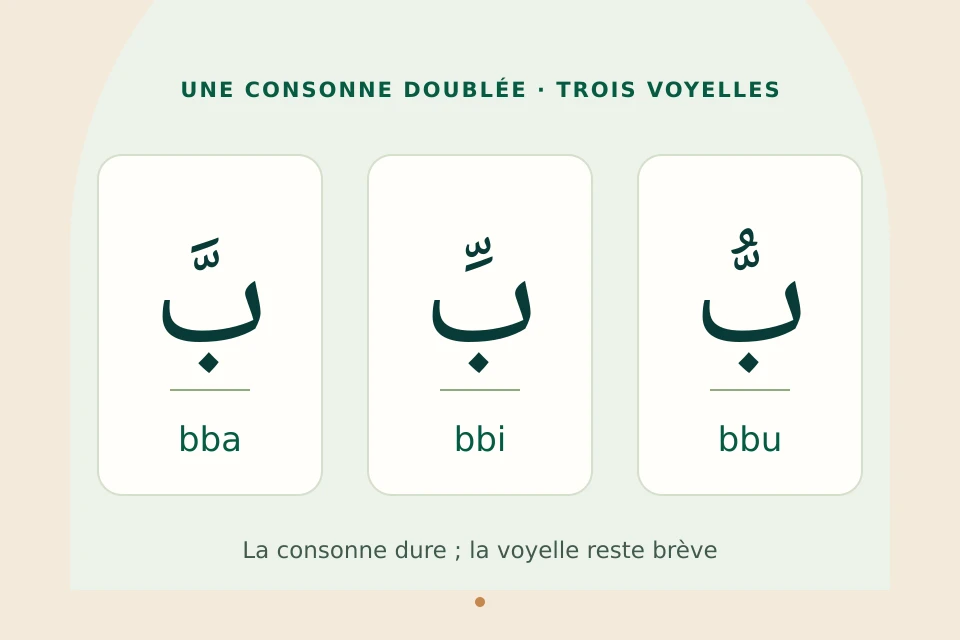
Shadda with fatha, kasra, and damma
Shadda specifies the consonant’s length. The vowel mark specifies what follows. Read them together, without giving each small mark an independent sound.
With fatha
بَّ
bba
Fatha is placed above shadda. After the doubled consonant, keep the vowel a short.
With kasra
بِّ
bbi
Depending on the typography, kasra may appear below the letter or just below shadda. It still represents a short i.
With damma
بُّ
bbu
Damma is placed above shadda. The consonant is doubled; keep the following vowel u short.
These groups show combinations of marks, not isolated words to pronounce without context. To read them naturally, start from a preceding vowel, as in the examples below.
- عَلَّمَ · ʿallama · he taught: the lām is doubled and followed by a.
- مُعَلِّمٌ · muʿallimun · teacher: the lām is doubled and followed by i.
- يُعَلِّمُ · yuʿallimu · he teaches: shadda is still on the lām, even though other letters have damma.
- يُحِبُّ · yuḥibbu · he loves: the bāʾ is doubled and followed by u.
Endings are read here as written. The -un of مُعَلِّمٌ is tanwīn on the final mīm; it does not come from the shadda on lām. A consonant can also carry both shadda and tanwīn: حَقٌّ (ḥaqqun, a right) combines a doubled qāf with the ending -un.
03 · Length changes the reading
Compare a single and a doubled consonant
Compare دَرَسَ (darasa, he studied) and دَرَّسَ (darrasa, he taught). The short vowels are the same. Shadda on rāʾ distinguishes the second form: da-ra-sa compared with dar-ra-sa. Doubling can therefore contribute to a difference in meaning and grammatical construction.
With م or ن, you can hold the sound a little longer. With ب or ت, hold the closure longer before releasing the air. Do not try to repeat each consonant twice in a choppy way. For less familiar sounds, work with a model of Standard Arabic and feedback from a person.
Shadda in the definite article
In الشَّمْسُ (ash-shamsu, the sun), the lām of the article is written, but its pronunciation assimilates to the following shīn. The shīn carries shadda. This happens with the letters known as “sun letters.” In الْقَمَرُ (al-qamaru, the moon), lām is pronounced and has sukūn. Learn this contrast without applying assimilation to every letter.
What if the vowel is not written?
Shadda may remain visible in a text where the other marks are omitted. It still indicates doubling, but on its own it cannot tell you which vowel to choose: a, i and u. The word and context supply the missing information.
04 · Correct your reading
Common mistakes with shadda
- Lengthening the preceding vowel. In عَلَّمَ, keep the first a short; give the lām more time.
- Inserting a vowel between the two positions. ʿallama does not become ʿalalama. The doubled consonant does not create an extra vowel.
- Confusing shadda and tanwīn. The first doubles a consonant. The second adds a vowel ending followed by n in the appropriate connected reading.
- Overlooking a kasra close to shadda. Look at its position relative to shadda, not just its height relative to the letter.
To correct yourself, slow the word down, identify the relevant letter, and note the vowel that follows it. Then return to a steady pace: shadda should remain audible without becoming an exaggerated pause.
05 · Your turn to read
Shadda exercises with answers
1. Find the doubled consonant
Identify shadda in عَلَّمَ, مُعَلِّمٌ and يُحِبُّ. Which vowel follows the relevant consonant?
Show the Answer
The lām followed by a, the lām followed by i, then the bāʾ followed by u. The readings are ʿallama, muʿallimun, yuḥibbu.
2. Compare the two verbs
Read دَرَسَ then دَرَّسَ. What changes while the vowels stay the same?
Show the Answer
The length of rāʾ changes: darasa then darrasa. The first means “he studied,” and the second means “he taught.”
3. Understand the article
In الشَّمْسُ and الْقَمَرُ, in which word is the lām of the article pronounced?
Show the Answer
It is pronounced in al-qamaru. In ash-shamsu, it assimilates to the shīn, which is doubled.
Repeat the same words with the transliteration covered. You have grasped the principle if you identify the right letter, preserve its vowel, and maintain the doubling at a natural pace.
Frequently asked questions
Your questions about shadda
Is shadda an Arabic letter?
No. It is a mark placed above a consonant to indicate doubling. It is not one of the alphabet’s 28 letters.
Does shadda lengthen the vowel?
No. It applies to the consonant. A long vowel and a doubled consonant are two different things.
Where should kasra be placed with shadda?
Depending on the typography, kasra goes below the consonant or immediately below shadda. In both positions, it indicates a short i vowel.
Should I pronounce two separate consonants?
Doubling is generally realized as a consonant held longer or a prolonged closure. Do not insert a vowel between the two positions.
Why does shadda appear after the Arabic article?
Before a sun letter, the lām of the article assimilates to the following consonant. That consonant is then doubled and carries shadda in a vowel-marked text.