
Arabic alphabet · Short vowels
Fatha in Arabic
Fatha in Arabic is a small diagonal stroke above a consonant. It indicates a short a vowel after that consonant: بَ is read as ba. This mark is not one of the 28 letters; it helps you read a letter that is already there. This lesson teaches you to recognize it, keep the vowel short, and follow it through a word.
Recognize the mark, read a consonant with a vowel, then distinguish a short vowel from a long one. Nouns are shown without case endings for isolated reading; verb forms retain the vowels shown.
Recognize the mark and its position
The Arabic name is فَتْحَة. Look at بَ : the consonant is bāʾ and the mark indicates a. You therefore read the consonant before the vowel, even though the mark is above it. Arabic words are read from right to left; the mark stays associated with the consonant that carries it.
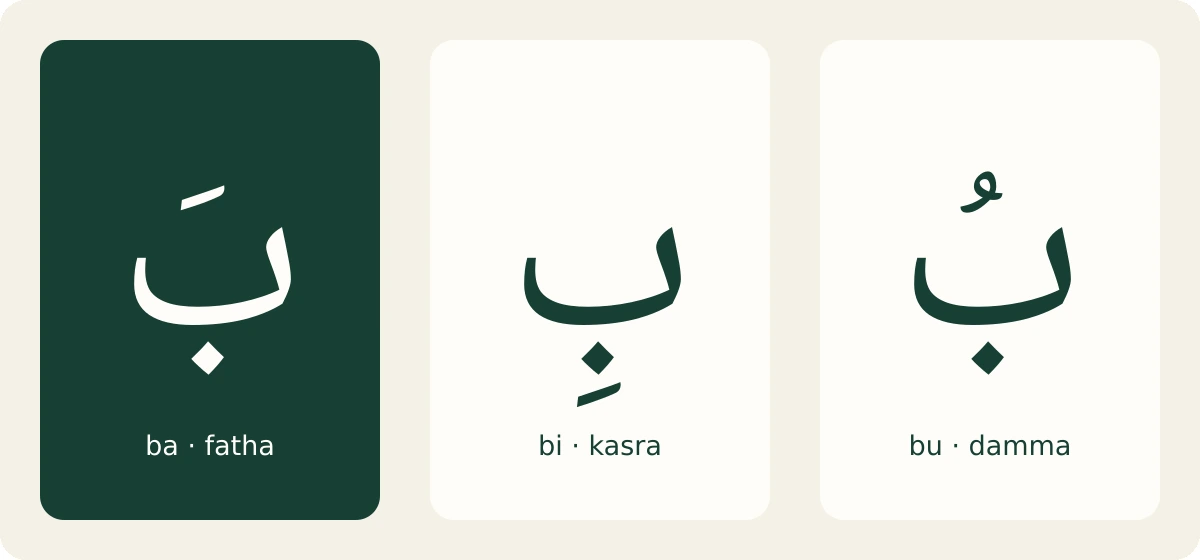
Dots and vowel marks serve different purposes. Dots identify certain letters; short vowels guide their pronunciation. In many texts for experienced readers, these vowels are not all written. A consonant with no visible mark should therefore not automatically be read as a consonant without a following vowel.
Pronounce the a sound without lengthening it
Pronounce ba in a single movement: start with b, then open your mouth for a short a. Do not say the letter’s full name, bāʾ, or add a second a. Next, try تَ (ta), مَ (ma), and سَ (sa). Keep the vowel equally short when the consonant changes.
The a may sound more open or farther back depending on neighboring consonants, especially emphatic consonants. It remains the same short vowel in this lesson. Trying to achieve an identical vowel quality every time would distract from the first goal: recognizing the vowel and its length.
Next, compare بَ and بَا. Pronounce the first form briefly, then hold the vowel of the second a little longer without repeating it. The length mark in bā makes this contrast visible. It does not call for greater volume or stress on the syllable.
Read the mark in words with vowel marks
| Word | Reading | Meaning | What to notice |
|---|---|---|---|
| كَتَبَ | kataba | he wrote | Three consonants, three fatha marks: ka, then ta, then ba. The final a belongs to this verb form. |
| جَلَسَ | jalasa | he sat down | Read ja-la-sa without lengthening the vowels. The j is a transliteration symbol here. |
| قَلَم | qalam | pen | Two fatha marks are visible. The isolated reading used here stops at m. |
| بَاب | bāb | door | Fatha is followed by an alif of lengthening: the first syllable contains a long ā. |
First read while following the letters with your eyes, then cover the “Reading” column. Return to the transliteration only to check. The goal is to link Arabic marks directly to sounds without permanently relying on the Latin alphabet. Transliterations are simplified guides; they do not describe every detail of articulation.
In بَاب, alif lengthens the vowel after the first bāʾ. It does not join to the following letter, so the final bāʾ keeps its isolated form even at the end of the word. This shows why a consonant’s form also depends on its neighbors. Fatha does not create a join or change the basic letter shape.
The short vowel and alif of lengthening
Fatha on its own indicates a; in the usual combination of consonant + fatha + alif of lengthening, you read ā. Compare بَ and بَا without inserting a break between b and the vowel. Alif is therefore not “a larger version of fatha.” A hamza carried by alif, as in أَ, is a different case: it represents a glottal consonant followed by a.
Mistakes to avoid
Do not insert an alif after every fatha when copying a word. كَتَبَ does not become a sequence of long syllables. Do not confuse the fatha stroke with the dots that identify the consonant: moving the dot in ب changes the letter; moving the vowel stroke changes the vowel.
A short-vowel mark is also different from sukūn, which marks the absence of a vowel after a consonant, and shadda, which marks a doubled consonant. Tanwīn adds an ending containing n in connected speech; that is a separate learning step. To begin, identify the mark before looking for a grammatical rule.
Four progressive exercises
1. Recognize
In بَ, بِ and بُ, which form has fatha?
Show the answer
بَ : look for the mark associated with the a sound.
2. Build a syllable
Add fatha to م, then to س. Read both forms.
Show the answer
مَ and سَ : ma and sa, with a short vowel.
3. Compare vowel lengths
Which of the two forms contains a long vowel: بَ or بَا ?
Show the answer
بَا is read as bā. The letter of lengthening distinguishes this form from بَ.
4. Read without transliteration
Read كَتَبَ, then explain where each instance of the vowel studied here appears.
Show the answer
ka-ta-ba: each of the three consonants has a fatha.
If you hesitate, return only to the relevant step: the mark’s position, sound, or length. Repeating an example and explaining your choice is more useful than rushing through a long series. Once you understand all four answers, alternate the three vowels on the same consonant.
Frequently asked questions
Where is fatha placed?
Fatha is placed above the consonant it gives a vowel to. In بَ, the small stroke indicates a after b.
What is the difference between fatha and alif?
Fatha is a short-vowel mark. Alif is a letter that can lengthen a to ā, as in بَاب.
Is fatha always pronounced exactly the same way?
It represents short a. Its quality can vary with neighboring consonants without becoming a different written vowel.
Should I pronounce a final fatha?
It depends on the word and the reading context. For the verb form كَتَبَ shown here, the exercise uses the reading kataba. Grammatical endings and pauses require separate study.
Can you read without a written fatha?
Yes, with the necessary vocabulary and grammar. A text without vowel marks does not show all the vowels; you should not choose them at random.
Continue learning
Return to the Arabic alphabet guide for letter forms, or explore sounds further with the Arabic pronunciation guide.
Then compare the other two vowels: Kasra in Arabic · Damma in Arabic.