Arabic alphabet · Short vowels
Kasra in Arabic
Kasra in Arabic is a small diagonal stroke below a consonant. It indicates a short i vowel after that consonant: بِ is read as bi. The mark is small, but it can change how a word is read. This lesson helps you spot it below joined letters, then distinguish short i from long ī.
Recognize the mark, read a consonant with a vowel, then distinguish a short vowel from a long one. Nouns are shown without case endings for isolated reading; verb forms retain the vowels shown.
Recognize the mark and its position
The Arabic name is كَسْرَة. Look at بِ : the consonant is bāʾ and the mark indicates i. You therefore read the consonant before the vowel, even though the mark is below it. Arabic words are read from right to left; the mark stays associated with the consonant that carries it.
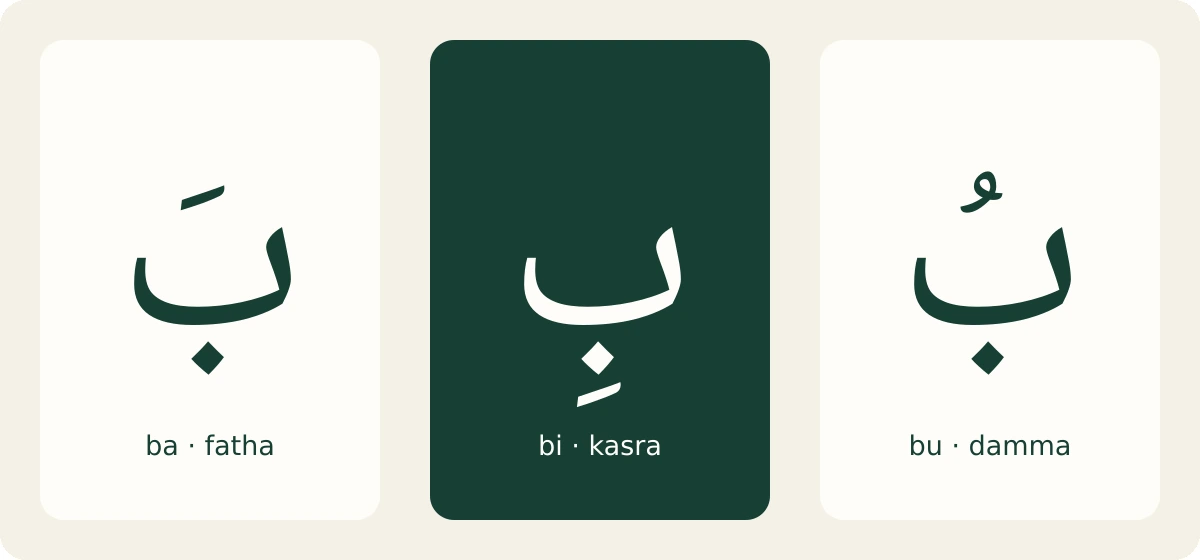
Dots and vowel marks serve different purposes. Dots identify certain letters; short vowels guide their pronunciation. In many texts for experienced readers, these vowels are not all written. A consonant with no visible mark should therefore not automatically be read as a consonant without a following vowel.
Pronounce the i sound without lengthening it
Say bi with a short vowel: the consonant b is immediately followed by i. Kasra does not add a syllable before the consonant. Continue with تِ (ti), مِ (mi), and سِ (si), with unrounded lips. Aim for a clear i without lengthening it to ii or gliding into another sound.
The transliteration i indicates how to read the vowel; it does not replace looking at the Arabic mark. With a difficult letter, first find the kasra, then practice the consonant separately. You may have identified the right vowel while still needing to refine the consonant’s articulation.
Next, compare بِ and بِي. Pronounce the first form briefly, then hold the vowel of the second a little longer without repeating it. The length mark in bī makes this contrast visible. It does not call for greater volume or stress on the syllable.
Read the mark in words with vowel marks
| Word | Reading | Meaning | What to notice |
|---|---|---|---|
| بِنْت | bint | girl | The kasra is on bāʾ. The nūn has a sukūn: no vowel follows it in this sequence. |
| كِتَاب | kitāb | book | The first i is short; the ā after t is long. One word can combine both vowel lengths. |
| سَمِعَ | samiʿa | he heard | The kasra is in the middle of the word, below mīm. The symbol ʿ represents the consonant ʿayn. |
| كَبِير | kabīr | big | The yāʾ of lengthening follows the consonant with kasra: read a long bī. |
First read while following the letters with your eyes, then cover the “Reading” column. Return to the transliteration only to check. The goal is to link Arabic marks directly to sounds without permanently relying on the Latin alphabet. Transliterations are simplified guides; they do not describe every detail of articulation.
In كِتَاب, the initial kāf has a kasra below its joined form. In سَمِعَ, the medial mīm carries the mark. Kasra stays attached to its consonant even when the letter’s outline changes. Look below each letter, not just below the whole word: several marks may appear near descending strokes or dots.
The short vowel and yāʾ of lengthening
Compare بِ and بِي : bi is short; bī is long when yāʾ serves as a letter of lengthening. Do not pronounce bi-yi in the second example. But not every yāʾ is a long vowel: in يَد (yad, hand), it represents the consonant y. Its role is determined by the word and the surrounding marks and letters.
Mistakes to avoid
Do not confuse kasra with the dot below ب : the dot belongs to the letter, while the stroke indicates the vowel. Do not automatically pronounce an i after every consonant in a word. In بِنت, the partial vowel marking does not justify adding vowels; the fully marked example for this exercise is بِنْت.
A short-vowel mark is also different from sukūn, which marks the absence of a vowel after a consonant, and shadda, which marks a doubled consonant. Tanwīn adds an ending containing n in connected speech; that is a separate learning step. To begin, identify the mark before looking for a grammatical rule.
Four progressive exercises
1. Recognize
In بَ, بِ and بُ, which form has kasra?
Show the answer
بِ : look for the mark associated with the i sound.
2. Build a syllable
Add kasra to م, then to س. Read both forms.
Show the answer
مِ and سِ : mi and si, with a short vowel.
3. Compare vowel lengths
Which of the two forms contains a long vowel: بِ or بِي ?
Show the answer
بِي is read as bī. The letter of lengthening distinguishes this form from بِ.
4. Read without transliteration
Read كِتَاب, then explain where each instance of the vowel studied here appears.
Show the answer
ki-tāb: short i after kāf, then long ā after tāʾ. The isolated reading stops at b.
If you hesitate, return only to the relevant step: the mark’s position, sound, or length. Repeating an example and explaining your choice is more useful than rushing through a long series. Once you understand all four answers, alternate the three vowels on the same consonant.
Frequently asked questions
Where is kasra placed?
In the basic examples, kasra is a stroke below the consonant. In بِ, it indicates the i sound after b.
What is the difference between kasra and fatha?
Both marks look like a small stroke. Kasra goes below the consonant and indicates i; fatha goes above it and indicates a.
Does kasra always produce a short i?
Kasra marks i. If a yāʾ of lengthening follows the consonant with kasra, the combination can represent long ī, as in كَبِير.
How do you read kasra with shadda?
The consonant is doubled and followed by the vowel i. Depending on the typography, kasra may appear below the shadda, above the body of the letter, or below the letter.
Does kasra always indicate a grammatical function?
No. It can be part of the body of a word, as in كِتَاب. A final kasra can also mark a grammatical function; this depends on the construction.
Continue learning
Return to the Arabic alphabet guide for letter forms, or explore sounds further with the Arabic pronunciation guide.
Then compare the other two vowels: Fatha in Arabic · Damma in Arabic.