
Dress in Arabic: فُسْتَان, plural and useful sentences
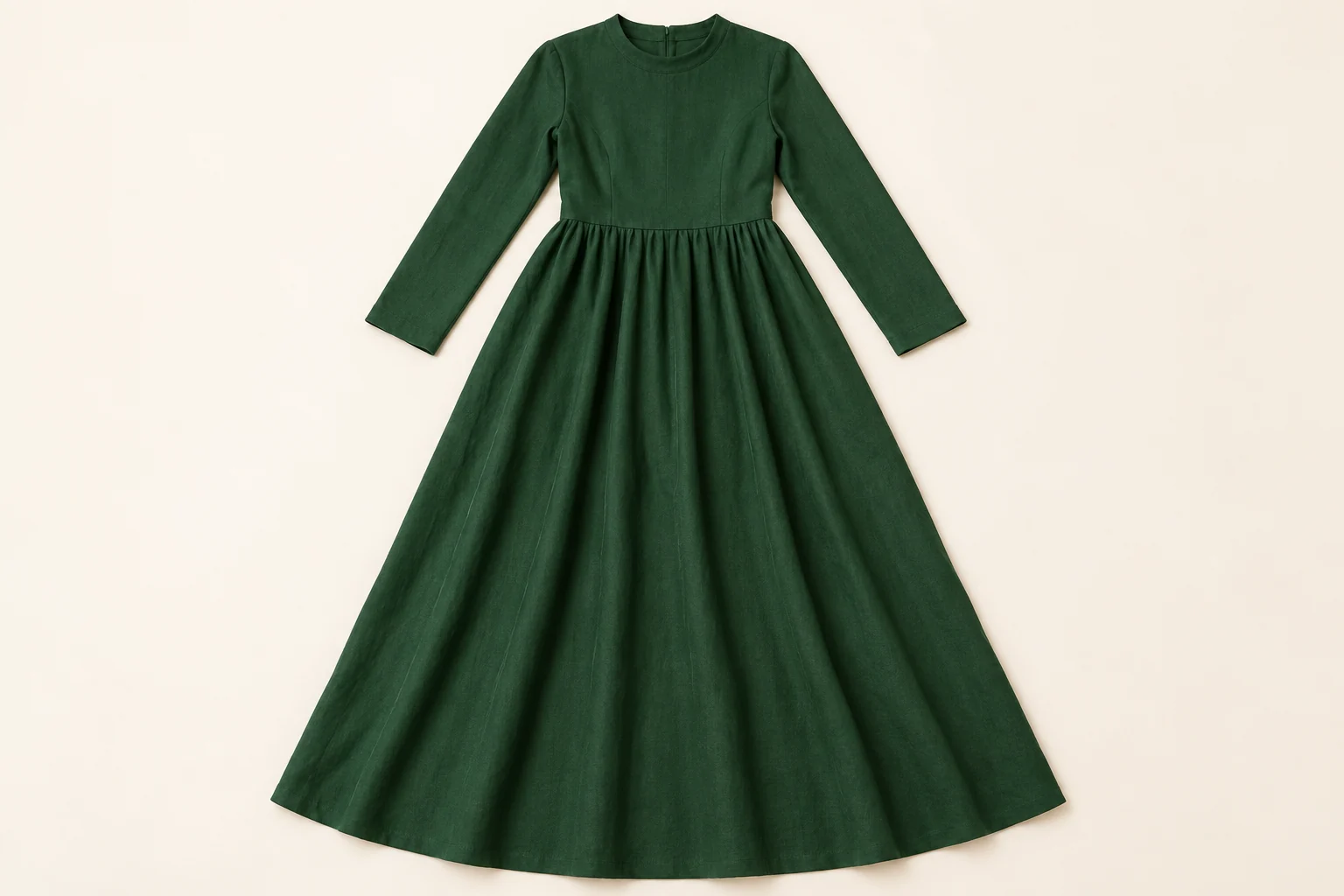
“Dress” is فُسْتَان (fustān) in Modern Standard Arabic. Its plural is فَسَاتِين (fasātīn). The noun is grammatically masculine, so a long dress takes a masculine adjective in Arabic. This lesson helps you read both forms, describe sleeves and fabric, and ask for a dress in a shop. It also distinguishes a dress from a skirt without using one word for every long garment.
Dress, dresses and my dress: essential forms
The isolated forms below are read at a pause, without case endings. Fasātīn is a broken plural: the internal word pattern changes. Do not form it by simply adding -āt to fustān. Learn the two words as a pair. Without short-vowel marks, they appear as فستان and فساتين ; the letters representing long vowels remain visible.
| Meaning | Arabic | Pronunciation |
|---|---|---|
| A dress | فُسْتَان | fustān |
| Dresses | فَسَاتِين | fasātīn |
| The dress | الْفُسْتَان | al-fustān |
| The dresses | الْفَسَاتِين | al-fasātīn |
| My dress | فُسْتَانِي | fustānī |
| My dresses | فَسَاتِينِي | fasātīnī |
Read fustān, then fasātīn
Divide the singular into fus–tān. The u is short and ā is long. There is no vowel after s, so avoid inserting one between s and t. For the plural, read fa–sā–tīn: the first a is short, then ā and ī are long. The bars indicate vowel length, not extra emphasis or an additional syllable.
Initial ف is a moon letter: the article’s l remains audible in al-fustān. Practise the word alone, then with the article, then with the suffix -ī in “my dress”. This trains the same base in three contexts rather than treating them as unrelated words. Transliteration supports Arabic writing; it does not replace it.
Why does dress take a masculine adjective?
Agreement follows the Arabic noun, not the person wearing the garment. Fustān is masculine: use hādhā for “this dress” and a masculine adjective such as ṭawīl, “long”. These descriptive sentences need no verb meaning “to be” in the present tense. The noun and adjective together form a simple first statement.
With several dresses, a nonhuman plural normally takes feminine singular agreement. Fasātīn remains plural, but the adjective becomes ṭawīla and the demonstrative hādhihi. In the vocalised example, fasātīnu ends in -u without -n: this plural belongs to a pattern that does not take tanwīn. No mark has been omitted.
| Arabic | Meaning |
|---|---|
| هَذَا فُسْتَانٌ طَوِيلٌ. | This is a long dress. |
| هَذِهِ فَسَاتِينُ طَوِيلَةٌ. | These are long dresses. |
Describe sleeves, fabric and length
When describing a dress, first choose the useful detail: length, fabric, fit or sleeves. A long dress does not necessarily have long sleeves; these descriptions concern different parts. In “with long sleeves”, the adjective describes the sleeves and takes the feminine singular because “sleeves” is a nonhuman plural.
| Arabic | Meaning |
|---|---|
| فُسْتَانٌ طَوِيلٌ | A long dress |
| فُسْتَانٌ وَاسِعٌ | A loose-fitting dress |
| فُسْتَانٌ مِنَ الْقُطْنِ | A cotton dress |
| فُسْتَانٌ بِأَكْمَامٍ طَوِيلَةٍ | A dress with long sleeves |
| فُسْتَانٌ أَزْرَقُ | A blue dress |
Dress or skirt: two garments, two names
A dress and a skirt use different nouns. A dress combines an upper and lower part; a skirt, tannūra, is worn from the waist down. Length alone therefore does not determine the word. Look at how the garment is constructed before considering its colour or style.
Fustān is not an automatic translation for every long outfit either: traditional clothing and indoor garments may have their own names. This lesson covers a dress in the ordinary clothing sense. If a catalogue uses a more specific term, keep the model’s description rather than inferring its name from appearance alone.
Choosing a dress: five practical sentences
The following sentences help you specify a choice, ask a question and express a preference. After “I am looking for”, the noun follows a preposition; after “I want”, it is a direct object. Final vowels can therefore change without changing what fustān means. Start by learning each sentence as a whole, then replace only the fabric or description.
| Arabic | Meaning |
|---|---|
| أَبْحَثُ عَنْ فُسْتَانٍ مِنَ الْقُطْنِ. | I am looking for a cotton dress. |
| أُرِيدُ فُسْتَانًا بِأَكْمَامٍ طَوِيلَةٍ. | I want a dress with long sleeves. |
| هَلْ هَذَا الْفُسْتَانُ مُتَوَفِّرٌ؟ | Is this dress available? |
| هَذَا الْفُسْتَانُ يُنَاسِبُنِي. | This dress suits me. |
| أُفَضِّلُ هَذَا الْفُسْتَانَ. | I prefer this dress. |
Your review: from a word to a description
Hide the Arabic column and recall “dress”, “dresses” and “my dress”. Check the long vowels in each answer. Describe one long dress, then several long dresses: which adjective changes? Finish by asking for a cotton dress. This combines three skills: recognising the form, choosing agreement and using the word in a practical situation.
Enrichissez votre vocabulaire
Des images pour élargir votre vocabulaire arabe
Le Robert & Collins – Dictionnaire visuel arabe
Après avoir étudié le mot arabe pour la robe, poursuivez avec des mots du quotidien associés à des images. Ce dictionnaire visuel français-arabe du Robert rassemble 4 000 mots et expressions illustrés, classés par thème. Son édition bilingue français-arabe convient aux lecteurs qui souhaitent s’appuyer sur le français pour explorer le vocabulaire arabe.
Lien affilié Amazon
Voir sur AmazonBuild your vocabulary
Explore Arabic vocabulary through pictures
Arabic English Bilingual Visual Dictionary
After studying the Arabic word for a dress, build on clothing vocabulary with DK’s visual dictionary. It groups everyday words by topic and pairs them with pictures. This is the 2024 English–Arabic edition.
Amazon affiliate link
View on AmazonWortschatz erweitern
Arabische Wörter mit Bildern entdecken
PONS Bildwörterbuch Arabisch: 1.500 nützliche Wörter für den Alltag
Nach der Lektion über das arabische Wort für ein Kleid können Sie den Wortschatz wiederholen und erweitern. Das deutsch-arabische PONS-Bildwörterbuch bietet 1.500 Alltagsbegriffe mit Bildern. Zu den Themen gehört auch Kleidung. Diese Ausgabe ist zweisprachig Deutsch-Arabisch.
Amazon-Affiliate-Link
Auf Amazon ansehenAmplía tu vocabulario
Descubre palabras árabes con imágenes
Diccionario de árabe 100% Visual
Después de estudiar la palabra árabe para el vestido, amplía tu vocabulario cotidiano con este diccionario visual español-árabe de Larousse. Reúne 2.000 palabras y expresiones organizadas en 80 temas cotidianos y acompañadas de imágenes. Es una edición bilingüe español-árabe.
Enlace de afiliado de Amazon
Ver en AmazonFrequently asked questions
How do you say dress in Arabic?
The Arabic noun for a dress is فُسْتَان (fustān). This lesson uses Modern Standard Arabic vocabulary.
What is the Arabic plural of dress?
For several dresses, use فَسَاتِين (fasātīn). This broken plural changes the pattern of singular fustān.
Is fustān masculine or feminine?
Fustān is masculine. The expression فُسْتَانٌ طَوِيلٌ means a long dress and contains a masculine adjective.
How do you say my dress in Arabic?
For my dress, say فُسْتَانِي (fustānī). For my dresses, use فَسَاتِينِي (fasātīnī).
How do you say a dress with long sleeves?
For a dress with long sleeves, learn فُسْتَانٌ بِأَكْمَامٍ طَوِيلَةٍ. The length described here concerns the sleeves, not the whole dress.
Do dress and skirt have the same Arabic name?
No: dress is فُسْتَان (fustān), whereas skirt is تَنُّورَة (tannūra). Choose according to the garment type, not only its length.
Continue learning clothes in Arabic
Compare a dress with other garments to reinforce differences in meaning and agreement. The clothing guide brings the vocabulary together; the following lessons explore individual garments.