
Glove in Arabic: قُفَّاز, plural and pronunciation
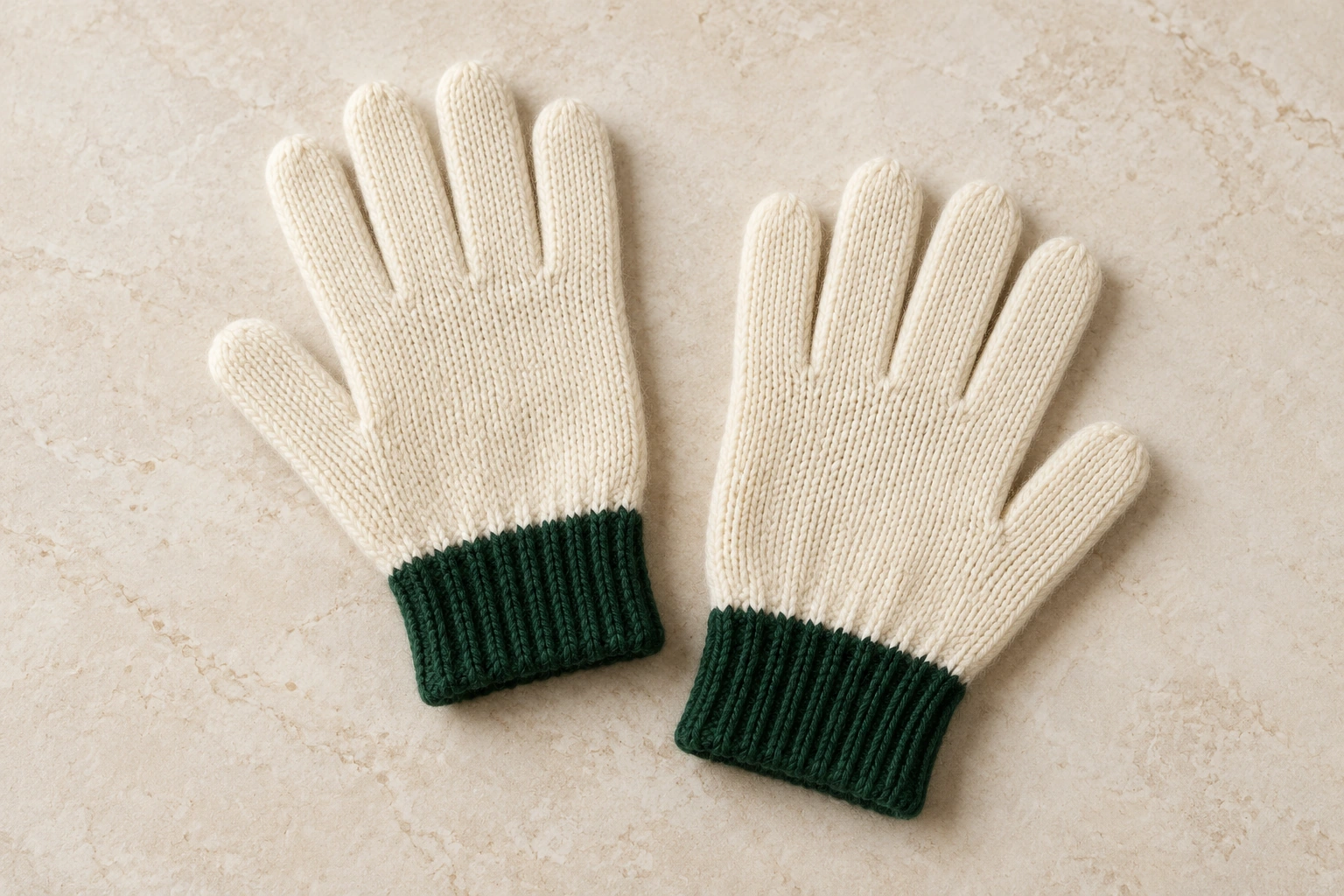
“Glove” is قُفَّاز (quffāz) in Modern Standard Arabic. For “gloves”, learn قُفَّازَات (quffāzāt). The noun is masculine in the singular. Since gloves often come in twos, this lesson also distinguishes the dual from the plural. You will learn to name a missing glove, describe its material and ask for a pair.
A glove, gloves and two gloves
In quffāzāt, add -āt to quffāz without removing its z. This ending does not make the singular feminine. Another plural, قَفَافِيز (qafāfīz), appears in dictionaries; focus on quffāzāt here. For “my glove”, add -ī: quffāzī. “My gloves” becomes quffāzātī. These possessive forms do not take the article al- before the noun.
To count exactly two gloves, use the dual: quffāzāni in the nominative and quffāzayni in the accusative or genitive. The plural can refer to gloves in general, but does not by itself specify a pair. The first six rows give vocabulary forms without case endings; the final two retain the dual endings to show the difference.
| Meaning | Arabic | Pronunciation |
|---|---|---|
| A glove | قُفَّاز | quffāz |
| Gloves | قُفَّازَات | quffāzāt |
| The glove | الْقُفَّاز | al-quffāz |
| The gloves | الْقُفَّازَات | al-quffāzāt |
| My glove | قُفَّازِي | quffāzī |
| My gloves | قُفَّازَاتِي | quffāzātī |
| Two gloves: nominative | قُفَّازَانِ | quffāzāni |
| Two gloves: accusative or genitive | قُفَّازَيْنِ | quffāzayni |
Pronouncing quffāz with a double f
Break the word into quf-fāz. The q represents ق, pronounced farther back than k. The u is short, roughly the vowel in “put”. The double f corresponds to the shadda: prolong the f sound without inserting a vowel between the two letters. Then lengthen ā and finish with a voiced z, as in “zero”, not an s.
In the plural quffāzāt, both ā vowels are long: do not shorten the first when adding -āt. With the article, say al-quffāz: q is a moon letter, so the l remains audible. The vowelled sentences below include grammatical endings in their transliteration. These help explain the construction; reading in pause may omit some endings.
Specifying the glove’s material and use
Quffāz names a garment or protective covering for the hand; it does not only mean “winter glove”. Specify the material or use to identify the item. A leather glove is not necessarily warm, and a cotton glove does not necessarily have a medical purpose. The following three phrases are original teaching examples: the adjective describes the glove without changing the noun’s meaning.
| Arabic | Meaning |
|---|---|
| قُفَّازٌ جِلْدِيٌّ quffāzun jildiyyun | A leather glove |
| قُفَّازٌ قُطْنِيٌّ quffāzun quṭniyyun | A cotton glove |
| قُفَّازٌ شِتَوِيٌّ quffāzun shitawiyyun | A winter glove |
Masculine singular, dual and plural agreement
In the singular, use quffāz with masculine hādhā, “this”, and jadīd, “new”. For several gloves, the noun refers to objects: this non-human plural normally takes feminine singular agreement in Modern Standard Arabic. Use hādhihi and jadīda instead. This plural rule does not apply to the dual: for two new gloves, the demonstrative, noun and adjective here each have a dual form.
| Arabic | Meaning |
|---|---|
| هَذَا قُفَّازٌ جَدِيدٌ. hādhā quffāzun jadīdun. | This is a new glove. |
| هَذِهِ قُفَّازَاتٌ جَدِيدَةٌ. hādhihi quffāzātun jadīdatun. | These are new gloves. |
| هَذَانِ قُفَّازَانِ جَدِيدَانِ. hādhāni quffāzāni jadīdāni. | These are two new gloves. |
Finding your glove and asking for a pair
The first-person sentences work regardless of the speaker’s gender. In “I wear two gloves”, quffāzayni is the direct object, so the dual takes the ending -ayni. To explicitly ask for a pair, use zawjan mina l-quffāzāti, “a pair of gloves”. Here zawjan is accusative after “I want”, while al-quffāzāti is genitive after mina.
| Arabic | Meaning |
|---|---|
| أَيْنَ قُفَّازِي؟ ayna quffāzī? | Where is my glove? |
| قُفَّازِي فِي حَقِيبَتِي. quffāzī fī ḥaqībatī. | My glove is in my bag. |
| أَلْبَسُ قُفَّازَيْنِ. albasu quffāzayni. | I wear two gloves. |
| أُرِيدُ زَوْجًا مِنَ الْقُفَّازَاتِ. urīdu zawjan mina l-quffāzāti. | I want a pair of gloves. |
Reviewing by changing the number of gloves
Cover the answers and translate three ideas: “my glove”, “new gloves” and “I wear two gloves”. Check the suffix -ī, the feminine singular adjective and the dual ending -ayni respectively. Then read quffāz and quffāzāt aloud, keeping the double f and long vowels. Finish with “where is my glove?” and its answer. This reviews a complete situation, not just a list of words.
Continuez à pratiquer
Un dictionnaire visuel pour élargir votre vocabulaire
Le Robert & Collins – Dictionnaire visuel arabe
Après le mot « gant », élargissez votre vocabulaire quotidien en associant mots et images. Le Robert & Collins – Dictionnaire visuel arabe est une édition français-arabe : son classement thématique permet de poursuivre vos révisions avec un support illustré.
Lien affilié Amazon.
Voir sur AmazonBuild your practice
Build your vocabulary with pictures
Arabic English Bilingual Visual Dictionary – DK
After learning the word for “glove”, build on clothing vocabulary with DK’s Arabic–English visual dictionary. It groups everyday words by topic and pairs them with pictures. This is an English–Arabic edition.
Amazon affiliate link.
View on AmazonWort für Wort
Den Wortschatz mit Bildern erweitern
PONS Bildwörterbuch Arabisch: 1.500 nützliche Wörter für den Alltag
Nach dem Wort für „Handschuh“ können Sie Ihren Wortschatz weiter üben: Das deutsch-arabische PONS-Bildwörterbuch bietet 1.500 Alltagsbegriffe mit Bildern. Zu den Themen gehört auch Kleidung.
Amazon-Affiliate-Link.
Auf Amazon ansehenPalabra a palabra
Amplía tu vocabulario con imágenes
Diccionario de árabe 100% Visual – Larousse Editorial
Después de aprender la palabra «guante», sigue ampliando tu vocabulario cotidiano. Este diccionario visual español-árabe reúne palabras y expresiones organizadas por temas y acompañadas de imágenes.
Enlace de afiliado de Amazon.
Ver en AmazonFrequently asked questions
How do you say glove in Arabic?
A glove is قُفَّاز (quffāz) in Modern Standard Arabic. The noun is masculine in the singular and names a garment or protective covering for the hand.
What is the plural of glove in Arabic?
Learn قُفَّازَات (quffāzāt), with two long ā vowels. Dictionaries also give قَفَافِيز (qafāfīz), so quffāzāt is not the only possible plural.
How do you pronounce quffāz with the article?
Say الْقُفَّاز (al-quffāz). The article’s l is pronounced because q is a moon letter. Keep the word’s double f and long ā.
How do you say my glove and my gloves?
“My glove” is قُفَّازِي (quffāzī); “my gloves” is قُفَّازَاتِي (quffāzātī). The suffix -ī expresses possession. Do not add the article al-.
How do you say two gloves in Arabic?
The dual is قُفَّازَانِ (quffāzāni) in the nominative and قُفَّازَيْنِ (quffāzayni) in the accusative or genitive. It indicates exactly two gloves, not an unspecified plural.
Why do you say quffāzāt jadīda?
Gloves form a non-human plural, so the adjective normally takes the feminine singular. Thus قُفَّازَاتٌ جَدِيدَةٌ (quffāzātun jadīdatun) means “new gloves”. The singular quffāz remains masculine.
Continue learning clothes in Arabic
Build your vocabulary with hat and coat, then find other garments in the clothing guide. The pronunciation guide helps you review the consonants and long vowels used here.