Vocabulary • Modern Standard Arabic
Colours in Arabic: masculine, feminine and examples
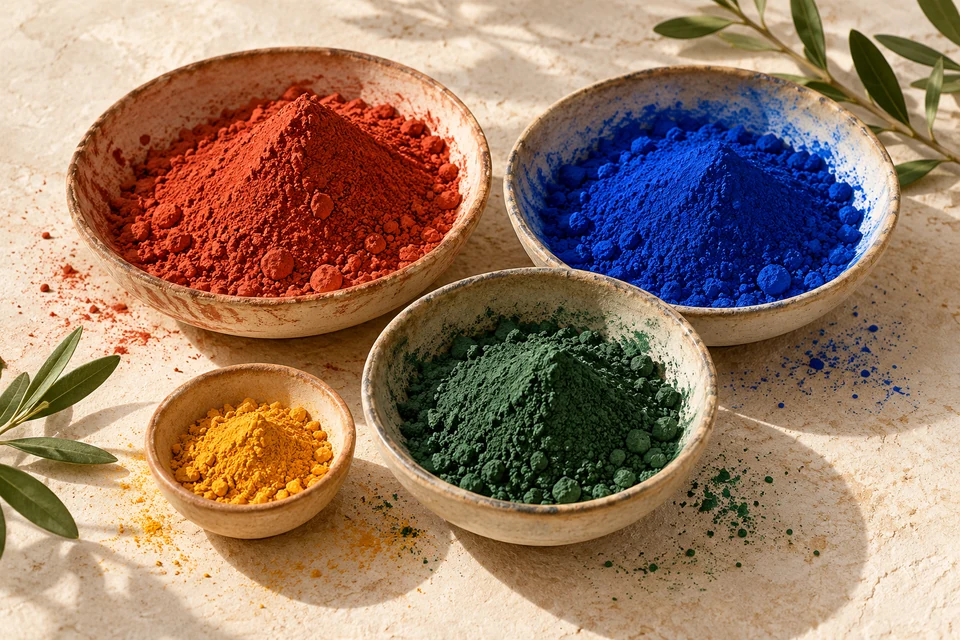
Red is أَحْمَر (aḥmar), blue is أَزْرَق (azraq) and green is أَخْضَر (akhḍar). These forms are masculine. To describe a car, a door or books, you also need the feminine forms and the rules of agreement.
Red, blue and green: learning forms in pairs
The word for “colour” is لَوْن (lawn), with the plural أَلْوَان (alwān). When describing an object, the colour word functions as an adjective. Learn the masculine and feminine together: the Arabic noun’s gender determines the form.
| Colour and guide | Masculine | Feminine | Lexical plural |
|---|---|---|---|
| Red in Arabic | أَحْمَر aḥmar | حَمْرَاء ḥamrāʾ | حُمْر ḥumr |
| Blue in Arabic | أَزْرَق azraq | زَرْقَاء zarqāʾ | زُرْق zurq |
| Green in Arabic | أَخْضَر akhḍar | خَضْرَاء khaḍrāʾ | خُضْر khuḍr |
The forms are shown without case endings. The plurals in the table are useful to recognise, but you should not automatically use them with every plural noun. For plural objects, Standard Arabic normally uses feminine singular agreement: كُتُب حَمْرَاء, red books.
Where does a colour adjective go, and how does it agree?
After the noun, following its Arabic gender
قَلَم أَزْرَق (qalam azraq) means “a blue pen”; سَيَّارَة زَرْقَاء (sayyāra zarqāʾ) means “a blue car”. Check the gender of the Arabic noun: بَاب, “door”, is masculine in Arabic.
A description or a complete sentence?
الْقَلَم الْأَزْرَق means “the blue pen”: both the noun and its adjective have the article. الْقَلَم أَزْرَق means “the pen is blue”: the adjective acts as the predicate. In the present tense, there is no separate word for “is” here.
The feminine changes the word’s structure
For these three colours, you do not simply attach ة to the masculine form: أَخْضَر becomes خَضْرَاء. This pattern does not apply to every colour. “Orange”, for example, is بُرْتُقَالِيّ (burtuqāliyy) in the masculine and بُرْتُقَالِيَّة (burtuqāliyya) in the feminine.
Pronunciation: three details that change the word
- In aḥmar, ح is an audible breathy throat sound and must not be left out.
- In azraq, ق is pronounced further back than “k”.
- In akhḍar, kh represents a single consonant, خ ; ḍ represents ض, an emphatic “d”.
The line over ā marks a long vowel. The symbol ʾ at the end of ḥamrāʾ, zarqāʾ and khaḍrāʾ represents hamza ء, a brief closure of the glottis. Do not replace it with an extra syllable.
Describing three objects around you
Choose a pen, a car and some books. First say their colour, then check the Arabic noun’s gender and number. Complete: قَلَم … (green), سَيَّارَة … (red), كُتُب … (blue).
Show the answers
قَلَم أَخْضَر ; سَيَّارَة حَمْرَاء ; كُتُب زَرْقَاء. In the last phrase, the plural refers to objects, so the feminine singular colour form is used.
Frequently asked questions
Do all colours form the feminine in the same way?
No. The three colours on this page have a feminine form ending in -āʾ, but derived colour adjectives, such as “orange”, follow a different pattern.
Should I learn the plurals straight away?
Start with the masculine, the feminine and one example. Learn to recognise the plurals in the table without using them in place of the feminine singular agreement normally used with plural objects.
How do you ask about colour?
مَا لَوْنُهُ؟ (mā lawnuhu?) means “What colour is it?” when referring to a masculine noun. For a feminine noun, say مَا لَوْنُهَا؟ (mā lawnuhā?).