
Window in Arabic: نَافِذَة and شُبَّاك
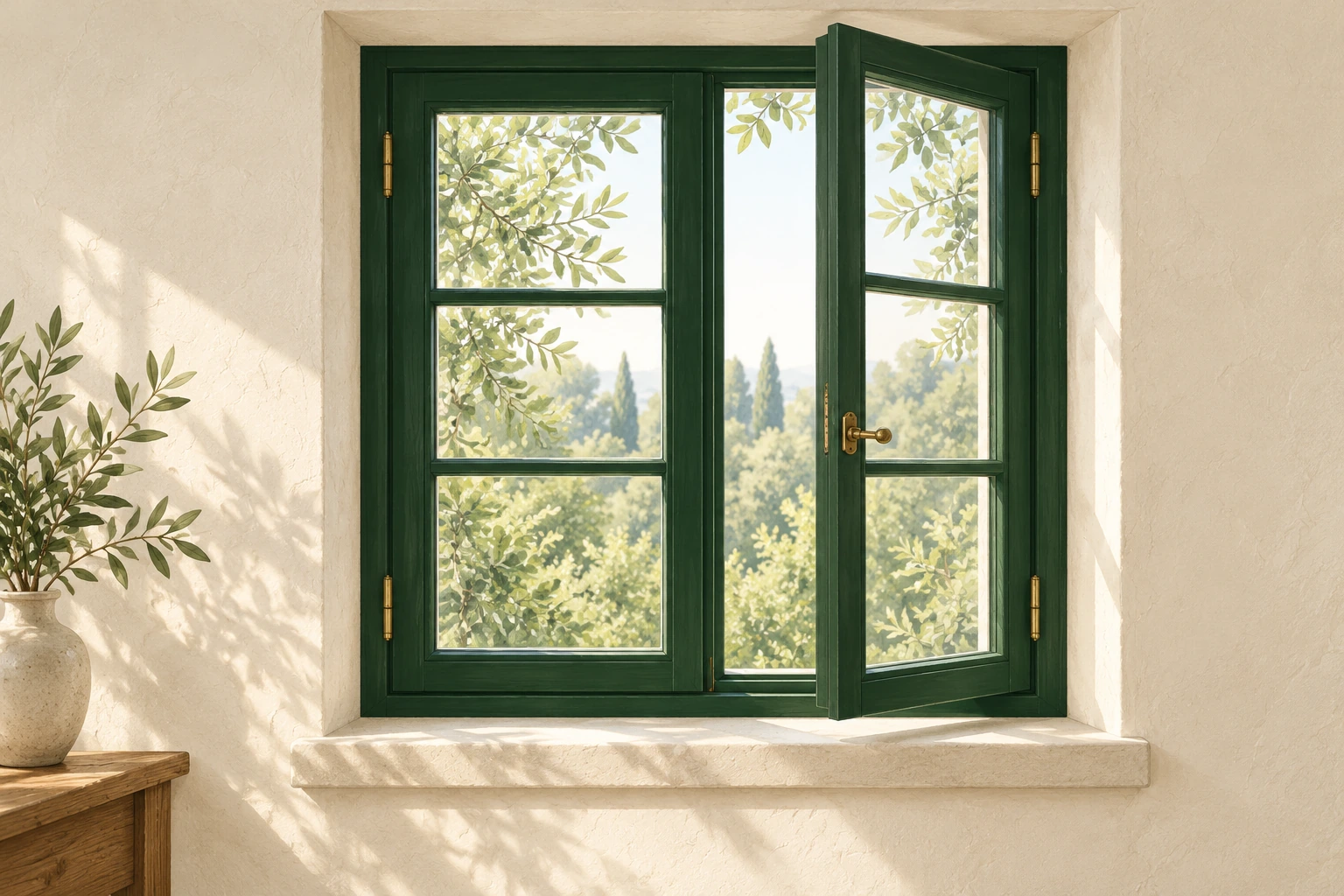
A window is نَافِذَة (nāfidha) in Standard Arabic. This feminine noun has the plural نَوَافِذ (nawāfidh). You will also encounter the masculine شُبَّاك (shubbāk), whose plural is شَبَابِيك (shabābīk). Learning both pairs helps you recognise the same object without confusing their grammatical agreement.
Two words for a window
In the vocabulary of the home, نَافِذَة refers to the opening through which light and air enter. The Cairo Academy also records شُبَّاك for a window. Do not present the first as the only correct word and the second as exclusively dialectal: both appear in dictionaries of Standard Arabic.
Singulars, plurals and gender
Both plurals are broken plurals: the word pattern changes. Learn nāfidha / nawāfidh and shubbāk / shabābīk as two pairs. The table gives words in their pause forms, without case endings. The feminine gender of nāfidha does not extend to its masculine synonym: agreement must change with shubbāk.
| Meaning | Arabic | Pronunciation |
|---|---|---|
| A window, feminine | نَافِذَة | nāfidha |
| Windows | نَوَافِذ | nawāfidh |
| A window, masculine | شُبَّاك | shubbāk |
| Windows, alternative noun | شَبَابِيك | shabābīk |
| The window | النَّافِذَة | an-nāfidha |
Pronouncing nāfidha and shubbāk
In nāfidha, ā is long. Dh represents ذ, the voiced sound in English “this”: let air pass at the teeth while your voice vibrates. It is neither a plain d nor a z. With the article, النَّافِذَة is read an-nāfidha: l assimilates to n, which is doubled. In shubbāk, sh represents ش, bb is doubled and ā is long.
The final letter ة in nāfidha needs attention. The isolated word at a pause is transliterated nāfidha. In grammatical connection, the t reappears: nāfidhatu in “the window of the house”. This change in pronunciation does not turn it into a different noun.
Window, bars or service window?
The Cairo dictionary lists shubbāk as a window fitted with a wooden or metal grille, but also as a window without this restriction. Do not infer the presence of bars from the word alone. The contemporary dictionary reproduced by Qabas also gives the meaning of a service window: references to tickets or a post office change the expected translation.
Three sentences about the home
These are original teaching examples. Transliteration shows grammatical endings, even at the end of a sentence; some endings are not pronounced at a pause. In the first sentence, maftūḥa is feminine, like nāfidha. In the second, the noun takes -a as a direct object. In the third, the construct phrase expresses “of” without a separate preposition, and the first noun does not take al-.
| Arabic | Meaning |
|---|---|
| النَّافِذَةُ مَفْتُوحَةٌ. an-nāfidhatu maftūḥatun | The window is open. |
| أَفْتَحُ النَّافِذَةَ. aftaḥu n-nāfidhata | I open the window. |
| هَذِهِ نَافِذَةُ الْبَيْتِ. hādhihi nāfidhatu l-bayti | This is the window of the house. |
Your turn: match the words
Hide the table. Which plural belongs to nāfidha? And to shubbāk? Then identify the feminine noun. Finally, translate “this is the window of the house” using the third example, and explain why nāfidha has an audible t there.
Answers: nāfidha / nawāfidh; shubbāk / shabābīk. Nāfidha is feminine. In nāfidhatu l-bayti, the noun forms part of a construct phrase and is not read in isolation at a pause: the tāʾ marbūṭa is pronounced t.
Frequently asked questions
How do you say window in Arabic?
A window is نَافِذَة (nāfidha). شُبَّاك (shubbāk) is also used. Both words are attested in Standard Arabic.
What is the plural of nāfidha?
The plural is نَوَافِذ (nawāfidh). For شُبَّاك (shubbāk), remember شَبَابِيك (shabābīk).
Is window masculine or feminine in Arabic?
نَافِذَة is feminine; شُبَّاك is masculine. Agreement depends on the Arabic noun you choose.
Can shubbāk also mean a service window?
Yes. Depending on the context, شُبَّاك means a window or a service window, such as a ticket window.
Continue around the home
Connect the window with the door and the house. Learn the word for book too, then explore the Home guide or other vocabulary topics.
Linguistic sources
The Cairo Arabic Language Academy records the meanings and plurals. Birzeit University’s Qabas identifies the genders and also documents the service-window meaning. The sentences were written for this lesson.